VTO Explorer and comparing a collection on your own face
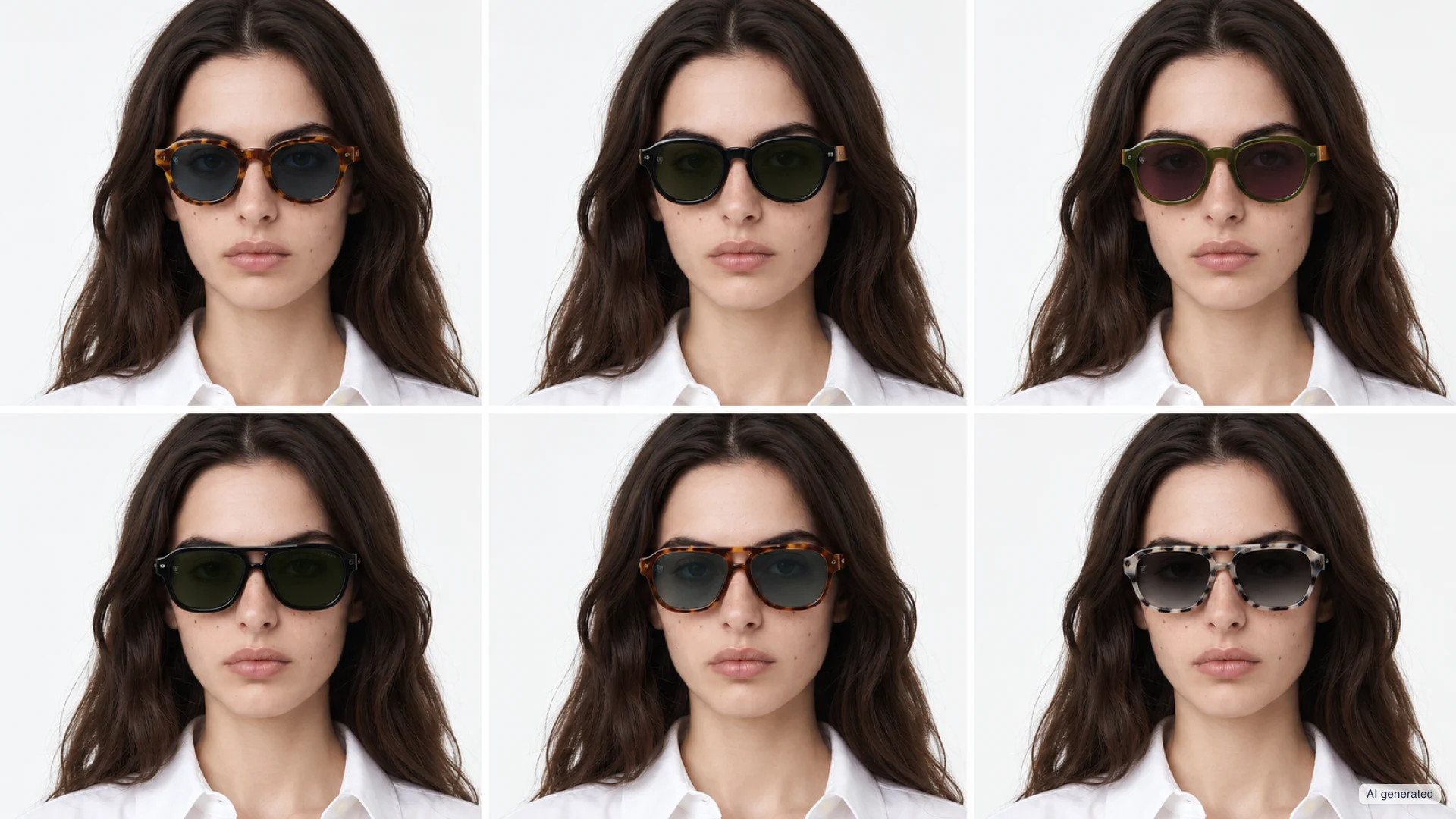
On a product page, the virtual try-on (VTO) comes into play once a frame has already caught the eye. An important part of the choice, however, happens earlier: deciding which styles deserve a closer look. VTO Explorer brings the on-face view into this phase, reusing a guided face capture to show several frames against the same reference. This changes the unit of comparison, the upfront effort the experience requires and the criteria for judging its quality.
In a traditional catalogue, products are compared through still-life photographs or on-model images featuring different people. Shoppers have to project those images onto their own faces. In personalised exploration, the relationship between frame and face becomes a direct part of how the range is presented.
The shift has consequences beyond replacing the images on the cards. The experience has to make variants comparable, preserve the quality of the capture and help build a shortlist without confusing what has been rendered with what has actually been assessed.
A common reference changes how frames are compared
In the live try-on used on product pages, the image follows the camera feed and the movements of the face. In the VTO Explorer approach, a guided capture provides images and geometric references that are reused to compose the views of the different variants. The capture can include several poses, which are then called up during exploration.1
Reusing the same reference keeps some elements of the comparison constant: the face, the captured pose, the framing and the shooting conditions. The difference between two images then lies mainly in the frames shown and how they are rendered. This can help to discern the relationship between frame front and face, the upper edge of the frame against the brow line or the effect of a colour, without rebuilding the visual context each time.
Comparability, however, requires the presentation to preserve physical differences. If every image is enlarged to fill the card, two different lens widths can look similar in size. Aligning the interface and keeping a scale consistent with the product are separate requirements, and need to be weighed together.
Pose plays a part too. The front view makes part of the relationship between frame and face readable; a side view adds information about the temples and the profile. To compare two styles, you need to know whether you are looking at equivalent poses and which views are actually available.
Capture quality becomes shared across the whole selection
A single reused capture reduces the need to repeat the flow, but carries its own conditions into every image that follows. Problematic framing, an inaccurate geometric reference or a poorly segmented area of the face can affect a whole group of frames.

There is only one capture: its flaws are repeated on every frame.
This gives rise to a distinction between shared errors and product errors. If many frames appear shifted in the same way, the check must include the face reference and the shared placement. If the anomaly affects a single variant, its asset and the associated information also need checking. Seeing a defect in several images taken from the same capture is not the same as confirming it across several independent captures.
The initial check must therefore make it possible to recognise conditions that would compromise later use: an unsuitable pose, a partly covered face, unfavourable lighting or difficulties during capture. Being able to review and redo the capture means the reference can be corrected before it is used on other products.
Final quality also depends on the interaction between glasses and face. The MEGANE research, presented at CVPR 2023, shows how complex it is to represent geometry, contact points, shadows and materials together, including metal and translucent plastic.2 It is a problem that a good starting photograph does not solve on its own: the frame must be accurate, and the composition must respect its relationship with the face.
A personalised image and advice on what to choose are different capabilities
Showing several frames on the same face gives the shopper a personal reference for comparison. This does not mean that the system ranks products by their suitability or has determined which frame should be chosen.
A sort order may depend on the campaign, the range or the brand’s priorities. A filter can use declared product attributes. A recommendation system, by contrast, requires its own criteria, data and an evaluation of the quality of its suggestions. The design must make it clear which of the three is shaping the selection.
The same distinction applies to fit. An image can help in judging proportions and appearance, whereas temple pressure, how the frame physically rests on the face and comfort over time call for other checks. Frame measurements and a consultation with the optician therefore still have a role to play along the way.
For VTO Explorer, the specific contribution is making the on-face image available while browsing. The decision on which products to show, with which attributes and with what assistance, if any, remains part of the commercial and interface design.
The initial capture must be weighed against the shopper’s task
A guided capture asks for effort before any results can be seen. Its value to the shopper depends on how many alternatives they intend to explore and how much the personalised comparison helps them tell those alternatives apart.
For a shopper who needs to check a single frame they have already chosen, starting the live try-on may be a suitable route. For a shopper building a first shortlist, reusing the capture across several products can spread that initial effort over a larger part of the search. There is, however, no universal number of styles beyond which one route becomes preferable: what counts is the flow on offer and the real conditions of use.
The explanation shown before the capture must make the expected result clear. The shopper must be able to understand that they will see the collection on their own face, and have a way of continuing to browse it without switching this mode on. If results arrive progressively, the preparation status must be clear as well.
How the capture is handled is a further architectural choice. Local processing, storage in the browser and any upload of the images are three different things. The design must define which of them the chosen deployment provides for, how long the data is needed and how the shopper can remove their personalisation. Being able to render on the device does not, on its own, describe all of the service’s data flows. Clarity on this point is part of the experience: in research on the virtual try-on of glasses, the greater decision comfort that comes with spatial presence weakens as concerns about privacy practices grow.3
The personalised catalogue must stay browsable while it is being prepared
A broad range can require many compositions: each variant can be shown in each of the captured poses. A purely illustrative example of 24 variants with two poses gives 48 possible images, before even considering other products or new captures.
This workload does not have to come before every interaction. Progressive preparation can prioritise the products on screen and those the shopper asks for, while keeping the images already produced available. VTO Explorer’s orchestration separates capture from image preparation and handles rendering in batches of variants, also taking into account which of them are on screen.4
The choice involves a trade-off. Preparing many views in advance can make later comparison faster, but ties up network, memory and graphics capacity for content that may never be seen. Preparing only a few focuses the work on the relevant products, but can introduce waits while scrolling or changing filters.
The order of appearance must also remain intelligible. If one card is personalised before another because its asset arrives sooner, it should not look like a recommendation from the system. A delayed result and a product excluded by the filter are different states, just as an unavailable view and a variant that is not for sale are.
Quality control must consider these cases as well as how quickly the first image appears. Grid stability, filter persistence and behaviour after a new capture are all part of the comparison experience.
Making more products visible does not guarantee an easier choice
Personalisation can make a comparison more immediate without automatically reducing the number of alternatives the shopper has to assess. This is why the design goal goes beyond counting the frames shown.
Research on choice overload cautions against generalisation. The meta-analysis by Scheibehenne, Greifeneder and Todd found a mean effect of virtually zero, together with wide variation between studies.5 The later work by Chernev, Böckenholt and Goodman identifies relevant conditions such as choice set complexity, decision task difficulty, preference uncertainty and decision goal; taking these factors into account, the authors find a significant overall effect, in contrast with the earlier meta-analysis.6 The two studies diverge on the average result and agree on what matters for design: the conditions in which the choice is made.
For an eyewear catalogue, the design implication is to organise the comparison: consistent attributes, useful filters, recognisable colourways and a way to hold on to the frames already considered. A shopper looking to explore a collection freely and one who has to choose between three alternatives have different needs.
A saved shortlist, or a step through to a closer look, must keep the reference to the variant. If the shopper recognises only the image on their own face, but loses the style and colour when opening the product page, the benefit of the comparison ends the moment the view changes.
Measuring the contribution to shortlisting
When evaluating VTO Explorer, it is essential to distinguish between completed captures, rendered images, images actually displayed and deliberate interactions. The engine can produce many renderings as a result of a single initial action: that number describes the work done by the system, not an equal number of decisions by the shopper.
A useful analysis covers at least two stages. The first is the ability to get from the request for personalisation to a usable set of results, looking at timings, drop-offs and problems. The second concerns what the shopper does with those results: narrowing the shortlist, looking more closely at a frame, coming back to compare it or moving on to the sales channel.
Exposure matters. A product that is prepared earlier, placed higher up or included in the initial filters may receive more interactions. Interpreting a preference requires information about the presentation, as well as counts of how often products are opened. Metrics need to be designed and verified in the actual integration, without assuming that every step is already being recorded.
Time spent can also mean different things: engaged exploration, waiting for results to be prepared or difficulty deciding. Comparison with the previous experience must therefore take into account both operational quality and the shopper’s task. An effect on purchases or returns requires further evaluation, using the study design discussed in our in-depth article on the pilot project.
VTO Explorer lets shoppers bring their own faces into the way they browse a collection. The value of this mode depends on the ability to keep products comparable, make the preparation of results transparent and carry a recognisable shortlist through to a closer look. This continuity is the test of what personalised exploration contributes to choosing a pair of glasses.
Sources
-
ARShades Knowledge Base, VTO Explorer, Overview: how capture and variant rendering differ from the live try-on. ↩
-
Li, J., Saito, S., Simon, T., Lombardi, S., Li, H. and Saragih, J. (2023), MEGANE: Morphable Eyeglass and Avatar Network, CVPR, pp. 12769–12779. ↩
-
Hilken, T., de Ruyter, K., Chylinski, M., Mahr, D. and Keeling, D. I. (2017), Augmenting the eye of the beholder, Journal of the Academy of Marketing Science, 45, 884–905; study 4, conducted with a virtual mirror for sunglasses. ↩
-
ARShades Knowledge Base, VTO Explorer, Structure: capture, orchestration and rendering layers. ↩
-
Scheibehenne, B., Greifeneder, R. and Todd, P. M. (2010), Can There Ever Be Too Many Options? A Meta-Analytic Review of Choice Overload, Journal of Consumer Research, 37, 409–425, DOI 10.1086/651235; record in the University of Basel repository. ↩
-
Chernev, A., Böckenholt, U. and Goodman, J. (2015), Choice overload: A conceptual review and meta-analysis, Journal of Consumer Psychology, 25, 333–358, text published on the author’s website. ↩
Share
Send this article to a colleague or save the link.
Related insights
View all articlesFrom campaign to virtual eyewear try-on
Variant identity, ranges by market, persistent entry points and journey measurement. The choices that connect an eyewear campaign to the virtual try-on and the sales channel.
10 min read
Adoption and resultsDesigning a Virtual Try-On pilot that supports a decision
Test scope, quality criteria, audience assignment and uncertainty in the results. How to build evidence that helps you decide whether, and on what terms, to extend Virtual Try-On.
8 min read
Virtual Try-OnVirtual try-on for eyewear in 2026: what has changed and what to ask a provider
Proportions, realistic lenses, privacy and PD estimates in the browser: the criteria to check during a demo.
10 min read