AI product photography: what changes for an eyewear brand, and what the law requires
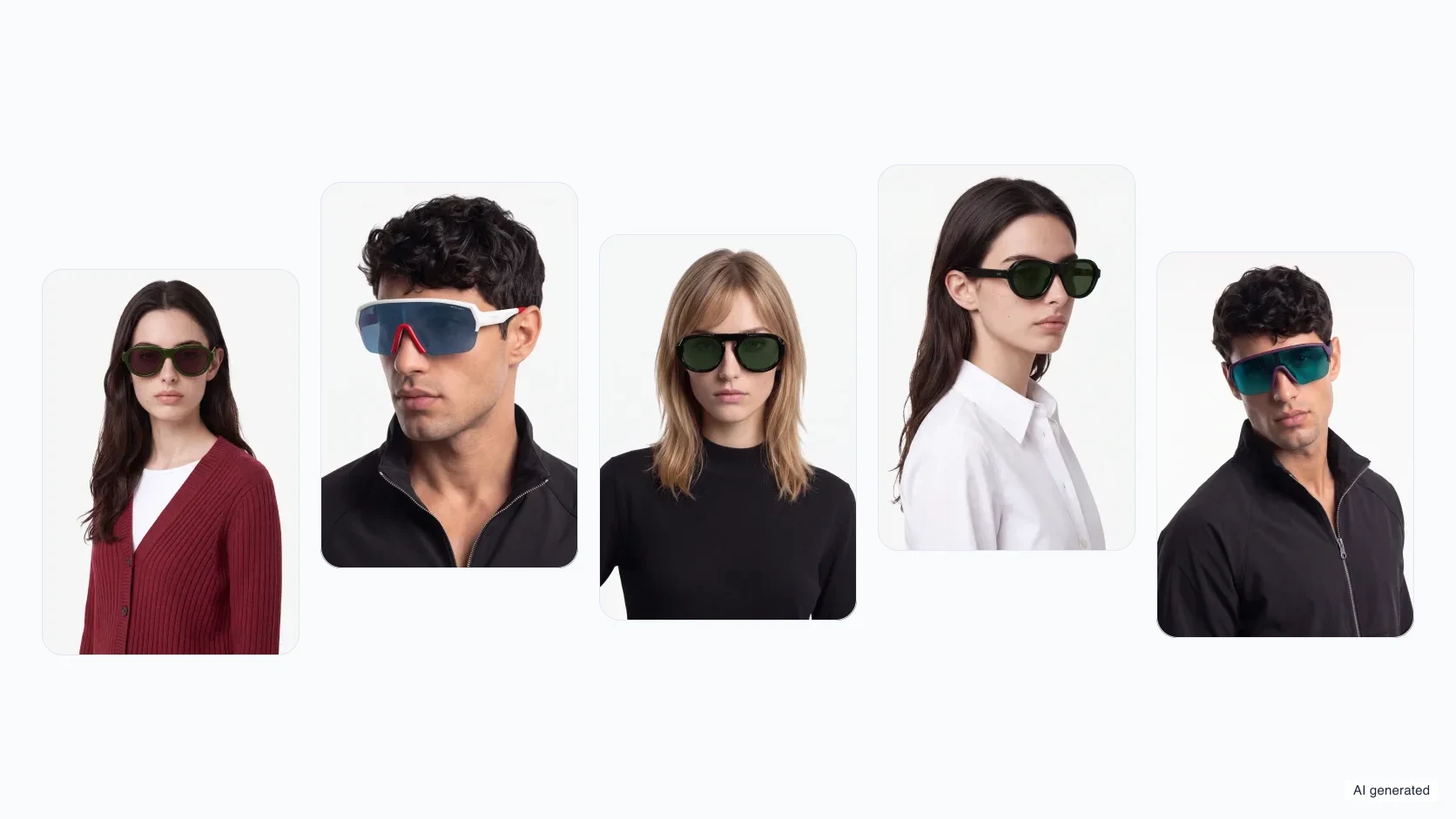
In 2024 a fashion brand published the first campaign generated entirely with artificial intelligence. In 2025 a major clothing chain and Europe's leading online fashion platform followed. In early 2026, eyewear joined them. Meanwhile, a European rule covering all of these images has started to apply.
This article sets out four things an eyewear brand needs to know before handing its photography over to AI: what others have done and what they kept constant, why eyewear is a special case, what the law requires of those who publish, and what it really takes to get a faithful photograph.
What others have done, and what they kept constant
Mango, July 2024. The campaign for the Sunset Dream collection of the Teen line was the first generated entirely with AI, and it was published in 95 markets. The process is instructive: first, real photographs of each garment in the studio; then an AI model trained on those photos to ‘dress’ the subjects; finally, the art team selecting, retouching and finishing the images.1
H&M, March and July 2025. H&M created ‘digital twins’ of thirty models, with their consent. The models keep the rights to their own copy and are paid as they would be for traditional photography. The first images, released on 2 July 2025, carry a watermark disclosing their artificial origin.2
Zalando, May 2025. About 70% of the editorial images in its campaigns in the last quarter of 2024 were generated with AI. Production times fell from six to eight weeks to three or four days, with costs cut by 90%. Zalando's VP Content Solutions explained that the point is not that AI makes better images, but that it makes it possible to produce new, relevant content fast enough to keep up with trends.3
Lenskart Middle East, January 2026. The eyewear retailer launched an AI-generated campaign for its Glint collection. To keep the products accurate, the AI model was trained on the entire collection before the frames were placed in the scenes.4
Four companies, four contexts, three constants. You start from the real product, photographed. At the end, a person decides, not the system. And those who do it most carefully disclose it.
Why eyewear is a special case
A garment forgives a degree of approximation: a different fold, an extra shadow. A pair of glasses does not. It is small, it sits in the middle of the face, and the difference between one frame and the next is the curve of the frame front, the thickness of the acetate, a logo engraved on the temple, the gradient of a lens. An image that ‘looks similar’ is not a slightly inaccurate photo: it is a catalogue error.
So the right question is not ‘Does AI take good photos?’ The question is: are those my glasses in the photo? Four checks help answer it, whatever the supplier.
- Where it starts. From photographs and measurements of the real product, not from a written description.
- Who checks. A person, against stated criteria: shape, colour, logos, materials, lens reflections.
- Who the people in the photos are. Either synthetic models, people who do not exist, chosen and approved before production; or digital twins of real people, with consent and payment, as H&M did. Both are legitimate routes. The second requires contracts.
- How corrections are made. With tracked versions, image by image, not by redoing everything.
A supplier that answers these four questions well is not selling an image generator: it delivers photographs.
What the law requires
The European regulation on artificial intelligence (Regulation (EU) 2024/1689, known as the AI Act) devotes Article 50 to transparency. The obligations apply from 2 August 2026 and also cover product images.5
What the law means by a ‘deep fake’. An image generated or manipulated by AI that resembles existing persons, objects or places and would falsely appear to be authentic. In the European Commission's guidelines, the test is perceived realism, not the intention to deceive, and the person depicted may even be fictitious. A photorealistic portrait of a model who does not exist, wearing a real pair of glasses, falls within the definition.6
The publisher must disclose it. The disclosure obligation falls on whoever uses the image, that is, the brand or retailer that publishes it. The disclosure must be clear, distinguishable and visible at the latest on first exposure to the image. A line in the terms of use or in a hidden menu is not enough. The exception for artistic or creative works does not apply where the commercial purpose prevails.6
The system provider must mark the files. Providers of systems that generate images must embed a machine-readable marking, for example in the metadata, that makes the content identifiable as artificial. For systems already on the market, the deadline has been moved to 2 December 2026.7
Penalties. For breaches of the transparency obligations, the AI Act provides for fines of up to €15 million or 3% of worldwide annual turnover.8
In Italy, there is an extra layer. Law 132/2025 introduced the criminal offence of unlawful dissemination of content generated or altered with AI: disseminating images of a real person without their consent, altered so as to mislead, and causing them unjust harm. It concerns digital twins of real people, not synthetic models: where there is no real person, there is no one to protect.9
| Who | What | From |
|---|---|---|
| The brand or retailer that publishes | Visibly discloses that the image is generated or manipulated | 2 August 2026 |
| The provider of the generating system | Marks the files in a machine-readable way | 2 August 2026; 2 December 2026 for systems already on the market |
| Anyone using the image of a real person | Has that person's consent (in Italy, otherwise it is a criminal offence if harm is caused) | Already in force |
Disclosure does not detract from the image
Many people's first instinct is to hide the label, for fear that it devalues the photo. The data show the opposite. In a Getty Images survey of more than 30,000 adults in 25 countries, almost 90% of people want to know whether an image has been created with AI, and 98% consider authentic images decisive in trusting a brand. The same research notes that AI-generated images of people, and those of real products, are perceived as more deceptive than images of abstract or other non-human subjects. That is exactly the case with a pair of glasses being worn.10
That is why disclosure should be seen as part of quality, not as a cost. A faithful pair of glasses, with the label, is worth more than an ‘almost identical’ pair without it. H&M chose a watermark for its first images for exactly this reason: so that customers understand straight away what they are looking at.
What to do now
- Choose images that start from photographs of your own product.
- Ask who checks each image, and against which criteria.
- Decide on casting: synthetic models, or digital twins under contract.
- Put the disclosure where it can be seen, on every channel: website, marketplaces, social media, print.
- Ask your supplier how it marks the files it delivers.
- Keep versions and approvals: if there is a compliance check, you can demonstrate the process.
How AI Photoshoots works
The three constants above — starting from the real product, letting a person decide, disclosing that the image is AI-generated — are also how ARShades produces AI Photoshoots photographs. It is worth explaining how, because each step answers a specific challenge in eyewear.
The product, in every detail
The challenge. An image generator works by resemblance. Describe a pair of glasses to it and it produces a plausible one: the right shape, roughly the right colour, a logo reminiscent of the real one. For a catalogue, that is not enough. The pattern of a tortoiseshell acetate, the profile of a hinge, an engraving on the temple, the gradient of a lens are exactly what sets one frame apart from another, and they are the first details an ‘averaging’ generator loses.
How we address it. Every frame goes into production with real photographs of the product — front, three-quarter and close-ups of the logos — and with its measurements in millimetres. The images start from there, and refinement works only on the glasses, within an area controlled by a person: face, hair and background stay as they are in the proposal, the generated image option being refined. The product photographs are the only source. The system does not invent brand names, colours or logos: it reproduces them.
Logos, colours, reflections and size: the review criteria
The challenge. Four things give a generated image away. A logo can come out legible but slightly different. A colour shifts under simulated light, and a Havana (tortoiseshell) acetate turns reddish. The lenses reflect a scene that does not exist, or reflect nothing at all. And the size of the glasses on the face, unless you start from real measurements, is an estimate.
How we address it. Every image, for every view (each angle from which the glasses are shown), is checked against six stated criteria: background, size, crop, colour, reflections, logos. Each criterion is judged by a person, with the product photograph alongside. Only what passes all of them is delivered. Size is checked against the frame's real measurements, which are an input to every job.
The working method: what is automated and what stays human-led
The challenge. Producing one convincing generated photo is relatively easy. Producing hundreds — consistent with one another, tracked, corrected and delivered to the client's conventions — is a problem of organisation, not creativity. This is where many pilot projects stall.
How we address it. AI Photoshoots is a section of ARShades Studio. A list of all the frames in the job shows the status of each one. For every view, the system prepares the proposals automatically, and work carries on in parallel while the team reviews those already completed. There are dedicated tools for regenerating a view with a different pose, correcting inaccuracies in the glasses and changing the background colour. At the end, the export produces the images and the validation report. Two stages stay human-led by choice: model casting and styling, because they are decisions of taste and brand, not routine operations.
Checking before the client sees the proposals
The challenge. With many services, the client receives a folder of images and has to make the selection itself, discarding whatever does not work. That is work the client should not have to do, and it costs time on every round.
How we address it. The check against the six criteria happens before delivery. The client sees only proposals that pass, usually two for each view, and chooses. If a proposal is not convincing, the client flags it with a reason and the cycle runs again. A correction is not a blind redo: it starts from a precise note of what was wrong.
Versions and approvals, image by image
The challenge. With generated images, the risk is losing track: which version is the approved one, what has changed since the previous one, who said yes. Without a record, every change reopens everything.
How we address it. Every correction becomes a new version, with a side-by-side before-and-after comparison and the option to roll back. The client approves or requests corrections within Studio, one image at a time or in groups. The history is kept: in case of doubt, or in a compliance check, the path of every image can be reconstructed.
Images with no expiry and no territorial limits
The challenge. In a traditional photoshoot, the images never fully belong to the brand. Models' usage rights are bought for a period, for certain countries and for certain channels. When the period ends, or when you open a new market, you renegotiate or reshoot. It is a cost that comes back every season.
How we address it. The people in AI Photoshoots images are synthetic models: they do not exist, so there are no usage rights to buy or to renew. The photographs delivered belong to the client, for all its channels, with no limits of time or territory. The synthetic models remain part of ARShades' own toolkit and may also be used for other brands; a brand that wants a face reserved for itself can request one on an exclusive basis.
Whole collections, in the same light
The challenge. Photographing an entire collection with the same model, the same light and the same background takes days on set, and the next season it all starts again. Images of different SKUs, shot in different sessions, are rarely truly consistent with one another.
How we address it. With AI Photoshoots, casting and styling are decided once for the collection, and every frame follows the same process: the same views, the same check, the same delivery conventions. Capacity scales with the number of frames, with no set or scheduling bottlenecks. Special types, such as frames with clip-ons, also have dedicated views. The result is a catalogue in which every pair of glasses is photographed the same way, and the transparency label is applied as standard to every image delivered.
Explore AI Photoshoots and request a demo with a few frames from your catalogue.
Sources
-
Mango (10 July 2024). Mango creates the first campaign generated with artificial intelligence for its Teen line. Press release. ↩
-
H&M Group (July 2025). H&M continues its exploration of creativity with AI. · FashionUnited (28 March 2025). H&M to create 'twins' of models with AI. ↩
-
Reuters, republished by Retail Systems (7 May 2025). Zalando embraces AI for faster fashion content production. Interview with Matthias Haase, Vice President Content Solutions. ↩
-
Campaign Middle East (16 January 2026). Lenskart Middle East debuts Gen AI-led eyewear fashion campaign. ↩
-
Regulation (EU) 2024/1689 (AI Act), Article 50 ‘Transparency obligations’ and Article 3, point 60. Official Journal of the European Union. ↩
-
Baker McKenzie (2026). New EU guidance on AI transparency: what should companies be doing from 2 August 2026. On the European Commission's guidelines for Article 50 (draft of 8 May 2026). ↩ ↩2
-
Future of Life Institute. The EU AI Act's Transparency Rules: A Practical Guide to Article 50. On the postponement to 2 December 2026 under the ‘AI Omnibus’ agreement (May 2026). ↩
-
ICTRecht (August 2026). AI Act transparency obligations now in effect. On the penalties under Article 99. ↩
-
Agenda Digitale (2025). Legge italiana sull'AI: tutti i profili penali (in Italian). On Article 612-quater of the Italian Criminal Code, introduced by Law 132/2025. ↩
-
Getty Images (30 April 2024). Nearly 90% of Consumers Want Transparency on AI Images. VisualGPS report ‘Building Trust in the Age of AI’. ↩
Share
Send this article to a colleague or save the link.