From Feature to Infrastructure: Rethinking AR for Digital Eyewear
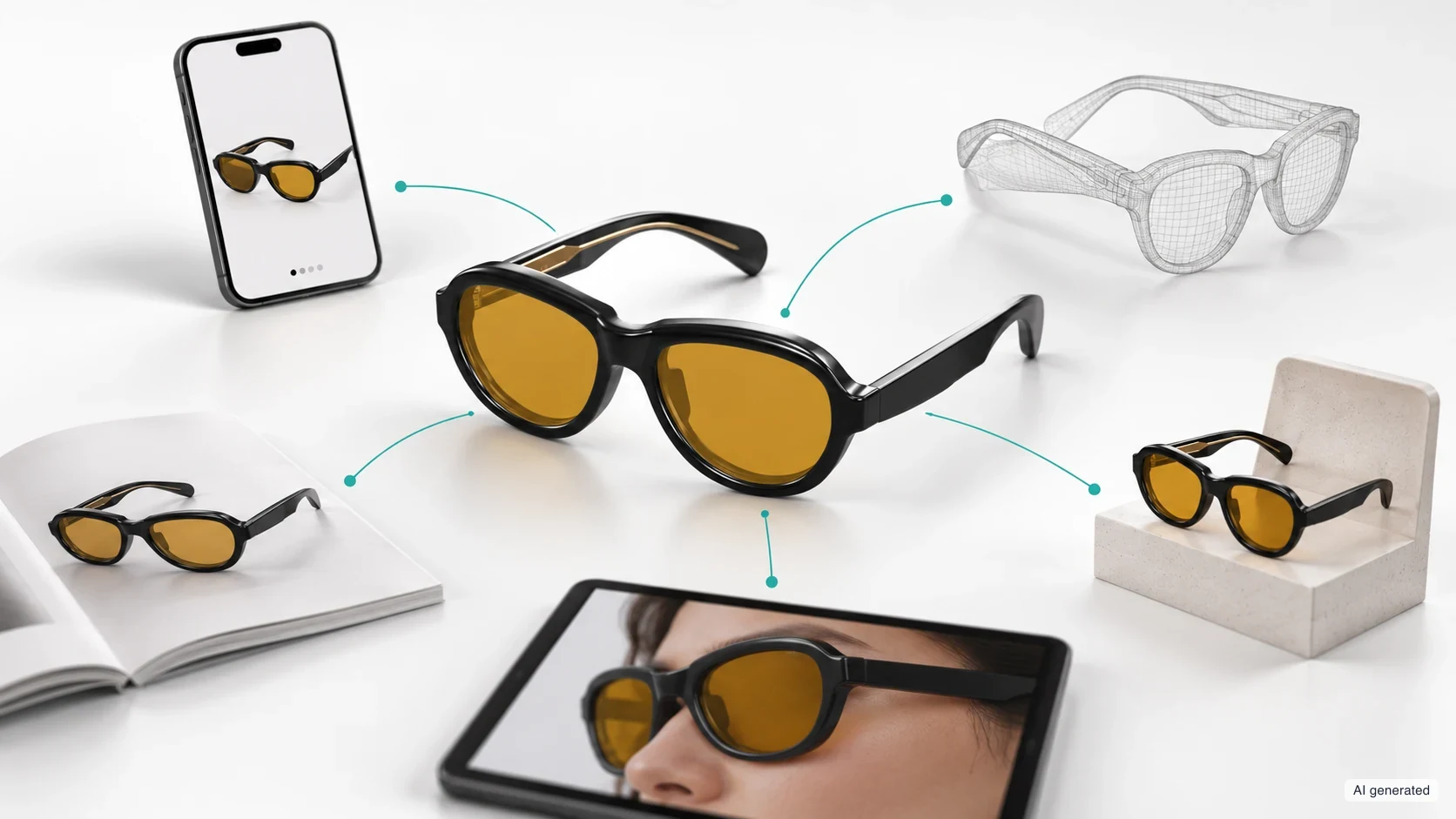
A brand adds virtual try-on to its online store for a clear reason: to help customers judge a frame before they buy it. The experience appears on a product page, but the work behind it begins elsewhere. Each physical frame needs a dependable digital representation: its geometry, proportions, materials, colour variants and lenses must remain recognisable as the frame moves with a face.
That investment can serve a much larger purpose. Once a collection exists in digital form, the question changes from “Where should we add try-on?” to “Where else would an accurate representation of this product be useful?”
A frame has more than one audience
The shopper wants to know how a frame looks on their face. They may also want to inspect the hinge, see the shape from the side or compare lens and colour variants. An interactive 3D viewer answers a different part of that decision from a virtual mirror. A study of an eyewear virtual mirror, published in the Journal of the Academy of Marketing Science, found that the sense of presence it creates can make customers more comfortable with their choice, although the effect weakens when they are concerned about privacy. The study measured comfort and intentions, not sales.
Before that frame reaches the shopper, a buyer may need to assess an entire collection, a sales team may need to present it across several markets, and an optician may need to show models that are not in the shop’s physical stock. In 2021 Silhouette opened a Digital Showroom where eyecare professionals could explore its latest collections from their own office or home, with one-to-one consultations guided by its experts. adidas reports that its own Digital Showroom made remote sell-in meetings more engaging with 3D digital samples and even improved its order book. And when Mister Spex opened its Vienna store, it paired around 900 frames on display with virtual access to its full range of more than 10,000 from over 100 brands.
These are distinct decisions, made by different people. The digital frame connects them.
Product imagery becomes part of the same story
A model that can be viewed interactively can also be rendered as still images. Camera angle, lighting, background and variant can change while the frame itself stays consistent. Ryders Eyewear used existing 3D production files to create images for its website and printed catalogues before physical samples arrived, according to a case study by its production partner.
Digital imagery can go further. The production partner behind Specsavers’ eyewear renders describes creating product images for successive launches and placing digital frames onto photographs of models; regional and global teams then used that content well beyond the original product shots.
Accurate renders can also provide product references for AI-generated model shots. This expands the range of faces, settings and formats a brand can explore. It also makes review essential: a convincing image is only useful if the frame shown is still the frame being sold. Research into digital eyeglasses and faces (MEGANE, CVPR 2023) shows how demanding that task is, particularly where frame and face touch, in the shadows each casts on the other and in materials such as metal and translucent plastic.
The same visual foundation can therefore support a product page, a buyer presentation, a printed catalogue, a social campaign or an in-store display. Each output may need its own preparation. The benefit lies in starting from a representation of the same product, rather than recreating it for every brief.
The work can begin before the launch
This flow does not have to start with a finished frame in a photography studio. Design and production data can help teams evaluate a model, present variants and prepare visual content while physical samples are still being made. Silhouette’s designers work from CAD data, produce 3D renderings to show colours and trims, and then test first models for function, size and wearing comfort (DEVELOP3D). Marcolin builds a physical prototype of each new product, using 3D printers among other technologies, and finalises its collections through renders, technical sheets and presentation materials (Sustainability Report 2025). The Ryders case shows production geometry being adapted for commercial imagery ahead of sample delivery.
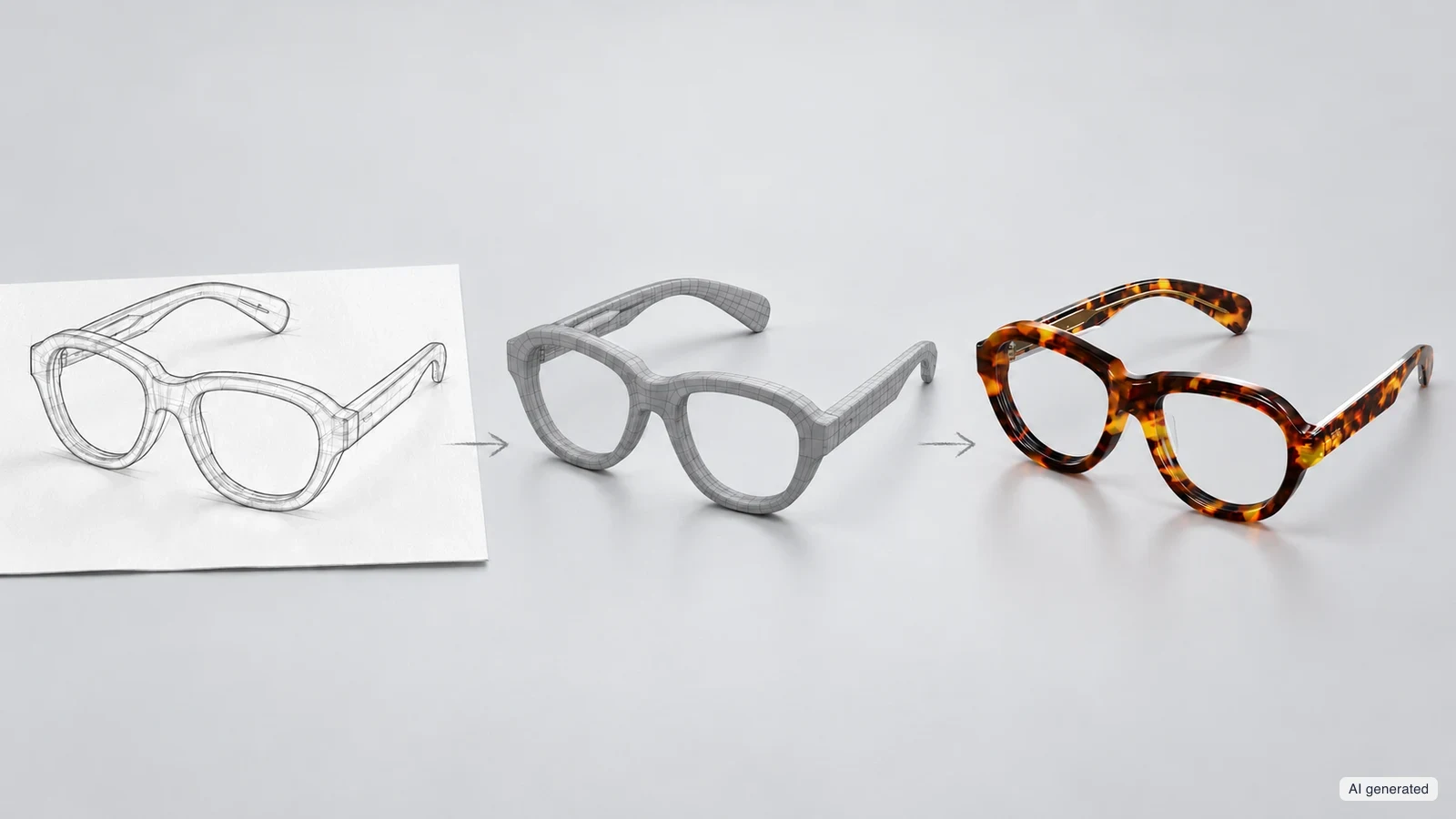
The models used for manufacturing, real-time AR and final campaign images have different technical demands. Even so, connecting those workflows creates an opportunity: decisions made in product development can inform what buyers and customers later see, and approved product changes can be carried into every later representation.
When reuse becomes infrastructure
EssilorLuxottica describes a centralised Render Factory that digitises its entire eyewear catalogue and produces the visual assets for its e-commerce platforms, B2B digital sales channels and product customisation services (2022 Universal Registration Document). Its 2025 Universal Registration Document describes a digital showroom with high-definition renderings and 360-degree views that has become a platform for remote selling, alongside in-store tools that combine augmented reality and virtual try-on. This is a concrete example of digital product representation becoming an operational capability across functions and channels.
At that scale, infrastructure means more than storing 3D files. Teams need to know which physical SKU and variant each asset represents, which version has been approved, where it is published and which images were derived from it. They need a way to correct a colour, replace a model or prepare a new collection without losing consistency across every destination.
Accuracy gives reuse its value
Quality becomes more consequential as reuse grows. In the Specsavers case, inaccurate digital product images had contributed to customer complaints and returns. A small discrepancy in a single image is already a problem; carried across a catalogue, a campaign and a try-on experience, it reaches much further.
Virtual try-on can be the first reason to digitise a frame. The lasting opportunity is a reliable digital product foundation that keeps generating value as new needs appear across design, sales, marketing and retail.
At ARShades, this is the principle behind our work. Each frame starts from the brand’s own material – CAD or 3D files, measurements, declared colours and reference images – and is checked against it before it is released. The approved model then feeds both Virtual Try-On and the 3D Viewer, each in the version it needs. The quality of a digital eyewear experience begins with how faithfully it represents the eyewear itself.
Share
Send this article to a colleague or save the link.